
 Feedback
Lighting Tips For Every Room
Posted by Best Access Doors on 4th Nov 2020
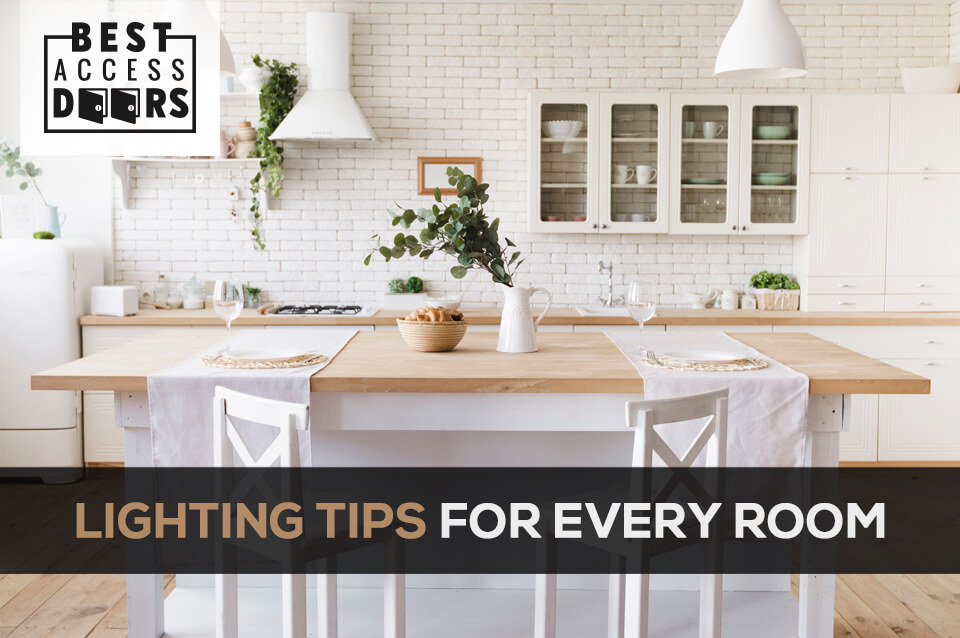
When discussing lighting in your home, “one light fits all” doesn’t apply to every area. Light changes the style and taste of a home. Depending on where and how you install the lampshade and its material, light sources with the same parameters will eventually produce different lighting effects, creating an entirely different atmosphere. Hence, when choosing proper lighting, it is essential to consider each room's functional and aesthetic needs.
A good starting point for any room is the overhead fixture. A dining room pendant light above the table or kitchen pendant lights over the island immediately anchor the layered lighting approach that the rest of this guide walks through.
Like an ecosystem, each room plays a unique role in how you, your family, and your guests live and interact. For this reason, each room has highly specific lighting requirements, which you should consider. More often than not, each room in a house requires layered lighting, just like a cake —each surface builds on the others to create a look that’s both appealing and functional. Best Access Doors is here to give you a closer look at how to improve lighting in every room.
1. Living Rooms / Family Rooms
Living rooms or family rooms are places where you, your family, and your guests typically spend a lot of time engaging in activities such as watching TV, reading, hanging out, or even using laptops. That’s why the concept of layered lighting is critical here. Ambient light bouncing off the ceiling suits the tendency for the eye to perceive vertical planes. It is particularly essential to apply the concept of layering light in the living room. In rooms where people spend most of their time, it is best to avoid recessed downlights and use ceiling-bouncing lights to achieve ambient illumination.
If you want to accomplish ambient lighting that bounces off the ceiling in a living room, it is recommended to integrate cove or valance lighting into the room’s architecture. Bookcases or entertainment units that don't go all the way to the ceiling also provide the perfect opportunity to add a piece of millwork and also put a linear fluorescent behind it. Another way of providing ambient lighting is to wash the walls with light. You can accomplish this with recessed or track lighting directed towards the walls, or even with plug-in floor lamp torchieres. Moreover, if you use a pendant light as the main light, you can place it slightly lower, directly above the coffee table, to make it the focal point of the sofa area.
2. Kitchen
More than any other area in your home, the kitchen needs a balance of layered task and ambient lighting, since the focus here is on food prep, cleanup, and serving as a gathering spot. You might want to consider a central ceiling-mounted fixture providing ambient light and task lighting for counters and over sinks where you do your kitchen work as a primary lighting plan for your kitchen. It would be best if you thought, in particular, of the task lighting for the counters and over sinks, where most of the work occurs.
This is why you'll find most sinks are beside windows-- to take advantage of natural light. Lighting experts recommend augmenting natural light with a ceiling-mounted or recessed fixture above your sink. Undercabinet lighting is also a good way to illuminate countertop work surfaces without relying on overhead lighting. This traditional lighting plan is sufficient for many kitchens and can be improved simply by putting all the lights on a dimmer and using energy-efficient bulbs.
3. Bathrooms
Just as bathrooms matter in any other building, they matter even more in houses. The bathroom requires careful planning of lighting placement. There are so many bathrooms that feature a central ceiling-mounted fixture casting shadows on someone standing in front of the mirror. Improving bathroom lighting may entail lighting both sides of the mirror. On the other hand, for older bathrooms, a conventional lighting design may feature a central ceiling-mounted fixture plus a fixture above the mirror. For an improved lighting plan, you would have to eliminate those fixtures and replace them with three wall sconces-- one on an opposing wall to offset the mirror position and two on either side of the mirror.
4. Outdoors
Outdoor lighting matters because it serves several purposes, including safety on pathways, aesthetic appeal, and security. One piece of advice for landscape lighting is to opt for quality fixtures for durability. When planning landscape lighting, it is better to light something close to the house, something midrange in the yard, and another in a far corner. With this strategy, you will be able to create interesting focal points when viewed from inside the house at night.
However, it would help if you kept in mind to avoid using too many outdoor lights. Creating super-bright areas also creates incredibly dark areas, which can be unsafe. An exception to this is the front door, one of the few outdoor areas where a brighter light can be acceptable under a traditional lighting plan that calls for two wall-mounted fixtures flanking the door.
5. Dining Rooms
For dining room lighting, the primary focus is the table-- and fixtures placed directly above the counter may provide both ambient and task lighting for the entire room. Dimmers are also ideal, as they provide flexibility in creating a relaxing atmosphere when entertaining guests. Another thing to consider when lighting a dining room is the wall treatment. This is because dining rooms often have decorative paint treatments or wallpapers. Most people probably know the traditional lighting plan for a dining room consists of a chandelier above the table and a pair of wall sconces that flank a prominent breakfront or sideboard, with all lighting on a dimmer. For an upgraded lighting plan, you might want to include cove lighting on two opposing walls and a dimmable chandelier.
6. Bedrooms
When it comes to bedroom lighting, bedside reading, and closet lighting are two of the primary concerns. If you want to improve bedside reading, most lighting experts suggest wall-mounted light fixtures with adjustable arms to redirect it onto the reading material. Keep in mind that each bedside light should have a switch, either on the fixture or at a wall switch within easy reach.
Architectural lighting, floor lamps, or a pair of sconces flanking a wall mirror can also provide ambient light. Since you want the bedroom to have a relaxing, sympathetic atmosphere, you should avoid central ceiling-mounted fixtures that might be perceived as harsh when viewed from the bed. You also have to consider the paint color of bedroom walls when planning light output because dark-colored walls reflect less light.
7. Home Offices
Home offices are essential. When designing a lighting plan, identifying where particular tasks will take place in the home office. One key consideration is making sure the light fixture won't reflect on a computer screen, so it is vital to know the computer's position. For desk areas, you must position the task light well to minimize shadows and reflections. That’s why it is essential to place it on the right or left side of the occupant’s main work orientation. Also, if the room’s layout permits, it will be useful to position a reading chair next to a window for natural light during the day.
Do you need help with your construction projects? You might find some of our blogs useful for construction projects. We have plenty of them covering different topics in construction. Visit www.bestaccessdoors.com/blog