
 Feedback
Why Smart & IoT-Ready Panels Are Gaining Traction in Commercial Buildings
Posted by Best Access Doors on 20th Mar 2026
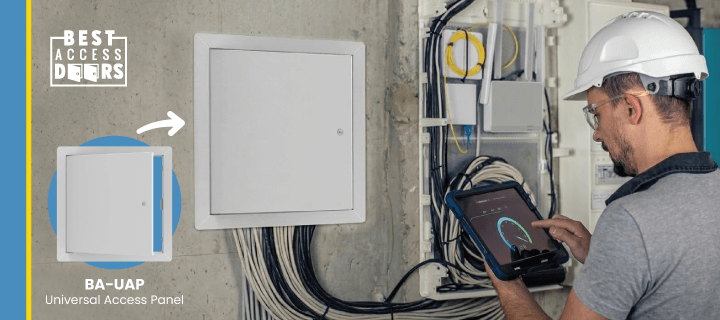
Smart and IoT-ready access panels are gaining traction in commercial buildings because they provide your team with reliable, repeatable access to the sensors, controls, and connected systems that smart buildings depend on, without cutting into finished walls and ceilings every time technology changes.
Projects that overlook access strategy often end up cutting into finished surfaces or delaying upgrades because there’s no clean way to reach critical equipment. This drives up lifecycle costs and makes “future-ready construction” much harder than it needs to be.
Smart building access panels, like BA-UAP Universal Access Panel, solve that problem by creating planned, standardized access points that can support multiple generations of technology without demolition.
In this article, we’ll look at what “IoT-ready” access means, when to plan access panels for commercial building technology integration, and how the BA-UAP access panel supports smart, connected upgrades.
What Does ‘IoT-Ready’ Really Mean for Commercial Building Access?
IoT-ready access in commercial smart buildings means your access panels are placed, sized, and specified so maintenance teams can safely reach sensors, controllers, cabling, and mechanical equipment that will evolve over the building’s lifecycle, without opening walls or ceilings each time the technology changes.
In practice, IoT-ready access panels help you:
- Reach Building Automation System (BAS) controllers, gateways, and power supplies.
- Service dense bundles of low-voltage cabling and network hardware.
- Maintain valves, dampers, and actuators tied to smart controls.
- Add or swap sensors as your smart building infrastructure grows.
Why Do Smart Building Systems Increase Access and Maintenance Demands?
Smart building systems increase access and maintenance demands because they add more devices, data points, and control interactions that must stay reliable for many years of operation.
MDPI research on IoT in buildings indicates that connected controls can reduce energy use by up to 30% and operating expenses by around 20%.
However, to achieve those savings, maintenance teams need reliable ongoing access to:
- Replace failed sensors before they degrade performance.
- Rebalance systems after tenant fit-outs or layout changes.
- Upgrade controllers and gateways as platforms evolve.
- Troubleshoot chronic issues using historical data and field inspections.
Without a clear access panel strategy for smart systems, doing any of those tasks can lead to:
- Cutting into finished walls or ceilings to reach hidden devices.
- Creating ad hoc access doors that don’t align with fire, acoustic, or design requirements.
- Increasing downtime because service teams can’t quickly locate and reach equipment.
That’s why IoT-ready access panels are becoming part of smart building infrastructure conversations because they help reduce lifecycle costs, simplify upgrades, and keep smart systems maintainable over the long term.
Explore our access doors and panels to learn how universal access panels can support smart and connected commercial buildings. You can also request a quote for our custom access solutions to coordinate non-standard sizes and configurations for your next IoT-ready project.
When Should Access Panels Be Planned for IoT and Smart-Building Integration?
Access panels should be planned during early MEP and low-voltage coordination. Ideally, it should happen at the same time you’re laying out your BAS, network, and sensor locations for your smart building systems and controls.
Aim to lock in your access panel strategy at these stages:
- Concept and schematic design
- Confirm that smart building infrastructure (BAS rooms, IT rooms, risers) has sufficient space and clear access routes.
- Identify where universal access panels will be used to provide access to mixed services (mechanical, electrical, low voltage).
- Design development and coordination
- Coordinate panel locations with equipment that will need regular inspection or replacement—actuators, valves, VAV boxes, junction boxes, gateways, and sensor clusters.
- Check clearances so technicians can safely work at the panel opening, not just reach through it.
- Construction documents and procurement
- Standardize on a small set of models (such as BA-UAP) for non-rated walls and ceilings, so access details are repeatable across floors and tenant spaces.
- Confirm hardware options (locks, gasketing, stainless materials) where security, air sealing, or corrosion resistance are critical.
- Fit-out and future tenant improvements
- Plan additional access points wherever smart systems branch to new zones, tenants, or use cases.
- Use the same access panel models and sizes to keep maintenance and stocking simple.
How Does BA-UAP Support Smart and Connected Building Upgrades?
The BA-UAP Universal Access Panel supports smart and connected building upgrades by providing your team with a durable, repeatable, and customizable access solution for non-rated walls and ceilings across your portfolio.
Let’s look at the key ways BA-UAP supports future-ready construction and smart building access strategies.
Universal Application for Evolving Systems
The BA-UAP access panel is a universal panel for non-rated gypsum and masonry assemblies in both walls and ceilings. This makes it ideal for:
- BAS controllers and smart HVAC components above corridors or in service areas.
- Plumbing, electrical, and low-voltage junctions where multiple systems share the same chase.
- General smart building infrastructure where you may need to add or reconfigure devices later.
Robust Construction for Repeated Access
Because smart and IoT systems rely on more sensors, controllers, and networked devices, your team will need to access these service points more frequently over the life of the building.
BA-UAP is built for that repeated use with features such as:
- 16-gauge cold-rolled steel for a sturdy, long-lasting frame and door.
- Hidden pin hinge, with a continuous piano hinge on doors over 24" in height or width, to prevent sagging and warping over time.
- Flush design with a 1" exposed flange that integrates cleanly with typical commercial finishes.
Security and Hardware Options for Smart Infrastructure
Many smart building devices control critical building operations. BA-UAP’s standard screwdriver-operated cam latch provides basic security, and you can specify upgraded hardware where needed.
You can choose from options such as:
- Key-operated cylinder cam latch for restricted access to control zones.
- Hex head and pinned hex head cam latches for tamper resistance in public or semi-public areas.
- Handle-operated cam latch where frequent operator access is needed.
- Mortise preparation for cylinder when you want to integrate a specific keyed cylinder.
Material and Gasketing Options for Performance
IoT-ready access panels may need to support envelope or environmental performance goals in addition to providing access.
As a result, BA-UAP comes with:
- Stainless steel 304 #4 (brushed finish) for corrosive or high-humidity environments, such as near mechanical rooms or coastal applications.
- Neoprene gasketing to help control dust, drafts, and minor moisture infiltration at access openings, which supports energy efficiency and comfort goals.
Supporting LEED and Lifecycle Strategies
LEED and other green building frameworks emphasize long-term energy and maintenance performance. Smart controls are a big part of that, but they only work when equipment is maintainable.
By giving your team consistent, durable access to sensors and controls, BA-UAP helps:
- Support lifecycle building management and planned maintenance.
- Reduce the risk of invasive rework during technology upgrades.
- Protect finishes and minimize disruption for owners and tenants.
And because BA-UAP is supplied with a high-quality white powder-coat primer, it can meet LEED low-emitting material criteria when coordinated with approved coatings and finishes that maintain indoor air quality.
Ready to align your access strategy with smart building infrastructure? Request a quote for BA-UAP to future-proof your access planning for smart building systems. You can also join our Pro Club to unlock exclusive benefits, support, and project resources.
Frequently Asked Questions on IoT-Ready Access Panels
1. How can access panels future-proof commercial buildings?
Access panels can future-proof commercial buildings by creating known, repeatable access points where maintenance teams can safely reach equipment that will change over time without opening up surrounding finishes.
2. Do IoT-ready access panels require different locations or sizes than standard panels?
IoT-ready access panels don’t always require special sizes, but they do require more intentional locations and clearances than many projects currently provide.
In many cases, using a universal panel like BA-UAP in a few standardized sizes (for example, small openings for single devices and larger openings for grouped equipment) is enough, as long as coordination with your BAS and low-voltage teams occurs early.
3. Are IoT-ready access panels more expensive than standard panels?
IoT-ready access panels are not automatically more expensive than standard panels. In most cases, the extra value comes from how you specify and standardize them (using the same models, sizes, and hardware across projects) rather than from any special smart feature in the door itself.
The real cost factor is whether your access strategy supports smart-building upgrades without invasive rework, not the individual panel price.
To Sum It Up
Smart and connected commercial buildings can only deliver their full value when the equipment behind the walls is easy to reach, maintain, and upgrade. And that’s where IoT-ready and smart building access panels come in.
Panels like BA-UAP give your team a practical way to create a consistent framework for maintenance access strategy, commercial system integration, and long-term building adaptability without sacrificing durability or security.
If you’re planning or upgrading commercial smart buildings, now is the time to bring your access strategy into early coordination discussions. Contact our team or call +1-888-327-5471 to coordinate access panels that support future-ready construction goals.
Share our story - the 2025 version is available