
 Feedback
What Contractors Need to Know to Win Bids Faster with Modular and Prefab Builds in 2026
Posted by Best Access Doors on 12th Feb 2026
To win modular and prefab bids faster in 2026, you need to compete on speed, accuracy, and predictability, not just price alone.
Owners now favor contractors who can submit accurate modular bids quickly, standardize repeatable components, keep their supply chains predictable and reliable, and meet strict off-site code and inspection requirements.
This makes the “small” details in your bid package, like access panels, much more important than they might appear at first glance.
How you specify and standardize these panels can significantly impact your factory workflows. If you don’t plan your access solutions early and align them across units, they can slow down production, trigger RFIs, and introduce last-minute changes that hurt your schedule and margins.
With that in mind, we’ll break down what contractors need to know to win modular and prefab bids in 2026. We’ll also explore how selecting standardized, prefab-ready access panels from Best Access Doors can help you submit stronger bids, streamline fabrication, and deliver projects more efficiently from factory to site.
Why are Modular and Prefab Builds Changing How Contractors Win Bids in 2026?
Modular and prefab builds are changing how contractors win bids in 2026 because owners now prioritize speed, accuracy, and predictability over basic, lowest-cost pricing.
A 2025 industry analysis by McKinsey notes that modular construction is playing a growing role in addressing housing and infrastructure needs, with more than 700 companies operating in the industry. This rapid expansion is raising the bar for what owners expect from bidders.
Some of the key changes reshaping how contractors compete include:
- Speed: Bidders who clearly define access solutions in their modular bids can achieve faster bid turnaround and stay ahead of teams that need more back-and-forth.
- Accuracy: In traditional builds, minor drawing gaps may be resolved on-site. In modular and offsite construction projects, those gaps can pause a whole production line.
- Predictability: Owners want to know if the contractor can manage repeatable assemblies, deliver predictable results, and maintain consistent quality. That includes showing how access panels, MEP penetrations, and service openings will be handled in both the factory and the field.
Contractors who enter the preconstruction phase with standardized, code-ready access panel solutions demonstrate that they understand modular workflows and can protect both schedule and budget. This not only strengthens their bids but also positions them as lower-risk partners in a market where reliability matters as much as price.
Delivering speed, accuracy, and predictability starts with standardizing your access solutions. Browse our prefab-ready access panels to find the right fit for your next modular bid.
How Does Standardizing Access Panels Speed Up Prefab Bidding and Production?
Standardizing access panels speeds up prefab bidding and production by simplifying estimates and keeping factory workflows consistent.
Industry research by MDP on modular supply chains notes that one of the biggest barriers to modular adoption is an underdeveloped and fragmented supply chain, especially when projects rely on numerous components and one-off details.
Standardized components help stabilize that supply chain, particularly in large-scale prefabricated building systems.
When you choose one or two preferred access panel models and apply them across similar assemblies, you make every stage of the project more efficient.
As a result, estimators can base quantities on known, repeatable details instead of juggling numerous panel types and sizes. Likewise, procurement teams can focus on a smaller set of SKUs, negotiate better pricing for higher volumes, and mitigate the risk of ordering incorrect or non-compliant products.
Need help standardizing your access panels for modular projects? Contact our team or talk to our specialists directly at +1-888-327-5471 to get a prefab-ready access panel for your next bid package.
What Access Panel Features Matter Most for Modular Construction?
For modular construction, the most important access panel features are code readiness, adjustability, fast installation, service-friendly operation, and reliable availability.
Because modular and prefab projects replicate details across many units, access panels must support both compliance and efficiency at scale.
Key attributes to prioritize include:
Code-ready and inspection-friendly
Access panels should align with relevant fire, smoke, electrical, and energy requirements for the assembly they’re fitted in. Clear labels and ratings support smoother inspections and reduce the need for late substitutions.
Universal sizing and adjustability
Even in factory-built environments, small variations in framing and finishes can occur. Access panels with universal or adjustable designs help installers achieve a clean fit without excessive shimming or cutting.
Fast and consistent installation
Access panels that use familiar hardware and straightforward mounting reduce training time and keep installers moving. When the same detail repeats across modules, a well-designed panel can shave minutes off each unit, which adds up over a large project.
Service-friendly access
In healthcare, hospitality, education, public-sector, and multi-unit residential projects, long-term maintainability matters. Access panels should open and close smoothly, allow enough clearance for tools and technicians, and maintain a clean appearance in visible areas.
Reliable availability and lead times
Factory schedules depend on predictable deliveries. Selecting access panels with solid stock levels, standard sizes, and clear lead times helps avoid bottlenecks and last-minute scrambling during module production.
How Do Early Material Decisions Reduce RFIs and Delays?
Early material decisions reduce RFIs and delays by aligning DfMA (Design for Manufacturing and Assembly) and factory workflows before production starts.
In many projects, access panels are often chosen after major routing and layout decisions have been made. In modular and off-site construction, this approach creates unnecessary friction that tends to show up in a few predictable ways:
- Late decisions generate RFIs: If access panel models, sizes, and locations aren’t clarified during design and preconstruction, MEP (Mechanical, Electrical, and Plumbing) teams will raise RFIs around clearances, fire ratings, and responsibilities.
- Production pauses affect the entire line: Factories rely on steady, predictable workflows. When teams are waiting for access panel answers or material, modules can be held up in a particular station, impacting overall throughput.
Treating access panels as part of the core assembly, not just a finishing detail, helps your team minimize preconstruction RFIs and protect modular production timelines.
Which Best Access Doors Products Are Best Suited for Modular and Prefab Projects?
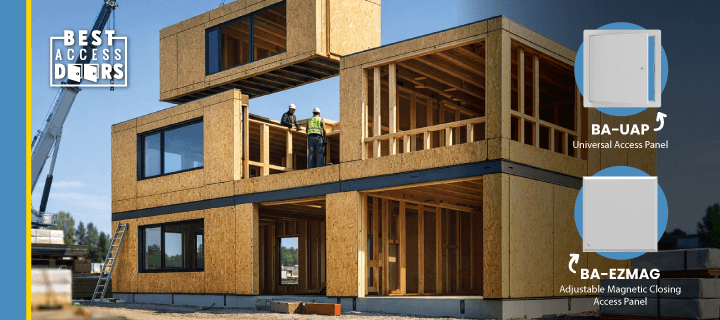
Best Access Doors offers a range of products that cater to the needs of modular construction. Two stand-out options for your prefab projects are the BA-UAP Universal Access Panel and the BA-EZMAG Adjustable Magnetic Closing Access Panel.
Let’s look at each of them.
BA-UAP Universal Access Panel
The BA-UAP Universal Access Panel is well-suited for modular projects that rely on consistent assemblies across multiple units. Designed for non-rated walls and ceilings, it provides a dependable access solution that can be specified once and repeated across corridors, service spaces, and common areas.
BA-UAP works well for prefab construction because:
- It enables standardization across modules: Its universal application allows the same panel to be used in multiple locations, which helps teams reduce variation across prefabricated units.
- It offers durable, long-term performance: Constructed from 16-gauge cold-rolled steel, the panel is designed to withstand frequent access and repeated use throughout the building's lifespan.
- It delivers reliable, smooth operation: The pin hinge system, paired with a continuous piano hinge on larger sizes, ensures consistent opening and closing without sagging, even when used across multiple modules.
- It provides flexible security options: Multiple latch and lock configurations allow teams to match access requirements without changing panel models.
- It supports clean, professional finishes: A flush design with a 1" exposed flange and a primed white powder coat makes BA-UAP easy to integrate into factory-built wall and ceiling assemblies.
BA-EZMAG Adjustable Magnetic Closing Access Panel
The BA-EZMAG Adjustable Magnetic Closing Access Panel is designed for prefab projects that prioritize speed, adjustability, and clean finishes. Its innovative magnetic closure and adjustable frame make it especially useful in factory environments where small variations in openings can occur.
BA-EZMAG works well in modular and prefab construction because:
- It adapts to varying opening sizes: Adjustable in 3/8" increments up to 1.5" in both width and height, BA-EZMAG can accommodate square or rectangular openings without custom fabrication.
- It installs quickly with minimal tools: The folding tab frame design and preassembled packaging support fast, consistent installation, which is ideal for maintaining production flow.
- It delivers a clean, flush appearance: A concealed 5/16" flange and magnetic closure create a neat finish that works well in high-visibility areas.
- It ensures secure, reliable access: Powerful concealed magnets and integrated security cables keep the panel firmly in place while allowing easy removal for service.
- It supports repeatable prefab workflows: Standard sizes, consistent materials, and simple installation make BA-EZMAG easy to apply across multiple modules.
Frequently Asked Questions About Access Panels for Modular Buildings
1. Do modular projects require different access panels than traditional buildings?
In most cases, modular projects don’t require entirely different access panels, but they do need earlier coordination and more consistent standardization. As long as the panel meets the code, fire, and energy requirements of the assembly, it can be used in both conventional and modular buildings, provided it's selected, documented, and coordinated before factory production begins.
2. Can I standardize one access panel model across multiple wall and ceiling types?
Yes. In many projects, you can standardize one or two access panel models across several wall and ceiling types, especially if you choose a universal or versatile panel such as the BA-UAP. That said, always verify compatibility with the assembly type, fire rating, and inspection requirements before choosing a single panel as your standard detail across the project.
3. When should access panels be specified in a modular project?
Access panels should be specified early—ideally during schematic design or early design development—when DfMA and BIM coordination are underway. By the time modular shop drawings are produced, panel locations, sizes, and models should already be agreed upon and integrated into standard details.
To Sum Up
In 2026, modular and prefab projects will reward contractors who can combine competitive pricing with speed, accuracy, and predictability.
When you standardize access panels for your modular buildings and choose modular-friendly features that support DfMA and repeatable assemblies, you make every project easier to deliver. Add in early material decisions that reduce RFIs and production pauses, and you strengthen both your bids and execution.
At Best Access Doors, we help contractors, estimators, and modular builders choose access panels that align with expectations for compliance and efficiency on both traditional and factory-built projects.
Request a quote today. Our team will help you standardize prefab-ready access panels so you can bid faster and win modular projects with more confidence.
Share our story - the 2025 version is available