
 Feedback
Which Access Panels Support LEED Points and Energy Code in Cold-Climate Builds?
Posted by Best Access Doors on 23rd Dec 2025
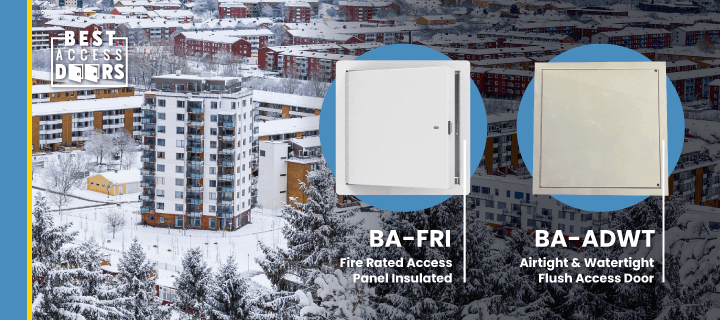
Access panels in cold climates have high-quality insulation, airtight construction, and proven weather resistance to support LEED points and energy efficiency. They reduce heat loss, thereby protecting the building's envelope.
Envelope failures in cold climates can happen fast. Moisture intrusion, rapid temperature swings, and high wind pressure all take their toll. That's why even small penetrations, such as access points, must perform at the same level as the surrounding wall or ceiling.
Cold-region contractors and architects are increasingly held to strict requirements under the IECC and NECB, as well as LEED v4/v4.1.
In this article, we'll explain why it's important to install insulated access panels for energy efficiency and how they support code compliance in cold regions. We'll then review the top Best Access Doors models that work best for cold-climate construction projects.
Why Do Cold-Climate Builds Require Insulated and Airtight Access Panels?
Cold-climate construction requires LEED-compliant access doors because any weak spot in the building envelope becomes a source of heat loss, condensation, and air infiltration. These can undermine code compliance and building performance.
Thermal Bridging
A poorly insulated access door acts like a heat-transfer point. It pulls warmth out of conditioned zones and allows cold to seep in. The result is a measurable drop in R-value, uneven temperatures, and an increase in heating demand.
High-R-value / insulation rating cores minimize heat transfer, maintaining consistent indoor temperatures.
Air Leakage
Without tight seals, cold air finds its way through the panel frame and perimeter gaps. The result is drafts and pressure imbalances. Buildings in Canada, the Northern U.S., and high-altitude regions feel this impact the most because temperature swings are sharper and wind loads stronger.
An airtight seal helps stabilize indoor humidity levels, preventing condensation that occurs in cold weather. In turn, it protects sensitive mechanical systems.
Weather Resistance
Exterior-rated airtight/watertight doors keep wind-driven snow, rain, and moisture out. Standard access panels here simply do not offer that level of weather protection.
Weatherproof access doors are built with heavy-gauge steel or aluminum frames and corrosion-resistant finishes. The reinforced frames ensure durability in coastal areas with cold climates and regions prone to freeze-thaw cycles.
Blower-Door Tests
LEED v4/ v4.1 reference blower-door tests to ensure the building envelope performance contributes to energy efficiency and indoor comfort. ASHRAE Standard 90.1 and codes like the IECC also require commercial buildings in certain climate zones to meet specific air leakage limits.
For context, blower door testing helps builders find out if a space's air barrier is intact. A single leaky access door can jeopardize the entire structure's airtightness score.
When a panel isn't insulated or sealed, a space will most likely fail this test. Failing a blower door test means contractors must identify leaky areas and reseal them to ensure a proper air seal. This leads to costly rework and delays in project schedules.
Insulated and airtight access solutions ensure your access points don't break a building's air barrier.
Browse insulated and airtight access panels designed for cold-climate energy code compliance. Call +1-888-327-5471.
Which LEED Categories Can the Right Access Panel Support?
The right access panel supports Energy & Atmosphere (EA), Indoor Environmental Quality (IEQ), and Building Envelope Optimization LEED categories.
It's important to note that access panels do not earn standalone credits but rather influence the building systems that do.
- Energy & Atmosphere (EA): Insulated and airtight access doors help reduce overall energy consumption, especially in climate zones with high heating demands. A better-performing envelope leads directly to improved energy models.
- Indoor Environmental Quality (IEQ): Airtight access panels help prevent drafts, humidity spikes, and moisture intrusion. They support comfort, air quality, and mold prevention. These benefits align with LEED's goals for stable interior environments.
- Building Envelope Optimization: LEED v4.1 emphasizes reducing envelope leakage and thermal bridging. An access panel with strong insulation and gasketing supports this objective by ensuring the envelope isn't compromised at service points.
Documented details like insulation, materials, and fire rating help teams prove the building meets energy codes and can earn LEED points. In cold climates where every unit of energy matters, these contributions are significant.
How Should Contractors Choose the Right Access Panels for Cold Climates?
Selecting the right access panel for a cold-climate LEED project requires matching the panel's insulation value, airtightness, and environmental durability to the performance of the surrounding envelope assembly.
In practice, this means:
- Determining the required R-value. The panel should equal or exceed the insulation level of the wall or ceiling.
- Evaluating air-barrier continuity. Panels used in energy-tested buildings need full-perimeter gasketing and latching systems that compress the seal properly.
- Choosing access panels based on their location. Watertight construction for exteriors; fire-rated panels for mechanical rooms; reinforced frames for roof penetrations, etc.
- Evaluating documentation. LEED and energy-code submissions rely on accurate specs. Think thermal resistance, material composition, fire certification, and airtightness details. At Best Access Doors, we provide detailed technical sheets, making it easier for contractors to meet compliance requirements.
Ensure your cold-climate project meets energy codes and earns LEED points with our insulated, airtight access panels. Contact us or call +1-888-327-5471 for expert guidance or to explore custom size options.
What Are the Top Best Access Doors Models for Cold-Climate LEED Projects?
For cold-climate, LEED-driven projects, the BA-FRI Fire-Rated Insulated Access Panel and BA-ATWT Airtight & Watertight Access Door deliver the insulation, airtightness, and durability your building envelope requires.
1. BA-FRI Fire-Rated Insulated Access Panel
This panel keeps your building energy efficient without compromising fire compliance codes. Here's what the BA-FRI excels at.
- Fire-Resistant Construction: 16-gauge cold-rolled steel frame, 20-gauge galvanneal steel door, mineral wool insulation, and quality gasketing. These slow heat transfer, maintaining fire-rated wall and ceiling integrity for up to 3 hours.
- Insulation Value: Integrated mineral wool reduces heat loss and thermal bridging, making the panel ideal for cold-climate builds and energy-efficient projects.
- Compliance With Standards: Tested according to UL 10B, CAN/ULC S104, NFPA 252, and ASTM E119 standards
- Automatic Panel Closer: Keeps the door securely seated after use, preserving fire-delay performance and airtight integrity.
- Customizable Materials and Finishes: White powder-coat primer standard, with stainless steel brushed finish available for demanding or visible applications.
- Easy Installation and Maintenance: Designed to fit seamlessly into walls and ceilings, the panel simplifies installation and daily access while maintaining envelope continuity.
This panel is best suited for installation in mechanical and electrical rooms, fire-rated shafts and corridors, and other fire-rated maintenance areas in cold climate regions.
2. BA-ATWT Airtight and Watertight Flush Access Door
This panel has an energy-efficient design that maintains air tightness, water resistance, and contamination control. Here's why the BA-ATWT is suitable for cold-climate and LEED builds.
- Superior Contamination Control: EPDM co-extruded trim-seal and precision gasketing prevent air, moisture, and contaminants from entering.
- Durability and Reliability: The heavy-duty 16-gauge steel door and frame withstand harsh conditions while maintaining structural integrity.
- Flush Design: Fits seamlessly into walls or ceilings, causing minimal disruption to the building's aesthetics.
- Compliance With Standards: Tested to ASTM E283/E283M, ASTM E331, and air infiltration standards.
- Improved Operational Efficiency: Maintains optimal environmental conditions to protect processes, equipment, and product quality.
- High-Performance Hardware: Continuous piano hinge and stainless-steel fasteners deliver smooth operation and long-term reliability.
BA-ATWT's is ideal for clean rooms, hospitals, laboratories, and exterior areas in cold climates.
FAQs About Access Panels for Cold Climate Construction
1. What makes an access panel suitable for cold climates?
Access panels for cold climates feature a high R-value insulation, airtight gasketing, and durable, weather-resistant materials. These prevent heat transfer, eliminate drafts, and protect the indoor thermal envelope.
2. Can airtight access doors improve blower-door test results?
Yes, because blower-door tests measure the leakage of a building's envelope. Using access doors with a tested airtight seal reduces uncontrolled air leakage through the wall or ceiling cavity. It helps projects achieve demanding IECC/NECB airtightness targets and energy efficiency ratings.
3. Do insulated panels reduce heat loss?
Yes. The primary function of an insulated panel is to minimize heat transfer. High-R-value foam or mineral wool cores reduce thermal bridging, ensuring the envelope's insulation remains continuous.
4. Are airtight access panels required for LEED?
While the LEED certification standards do not mandate specific access panel requirements, highly efficient airtight and insulated panels contribute directly to credits under the Energy and Atmosphere (EA) and Indoor Environmental Quality (IEQ) categories.
Conclusion
Access panels in cold climates enhance the building envelope. Insulated and airtight ones reduce heat loss and improve energy efficiency. They also support LEED categories such as Energy & Atmosphere and Indoor Environmental Quality.
Models like the BA-FRI and BA-ATWT help architects and contractors pass blower-door tests, maintain compliance, and deliver buildings that perform in the harshest conditions.
Cold climates demand high-performance panels that protect your envelope integrity. Request a quote today for our insulated, fire-rated, and airtight access doors and enhance your project's energy efficiency goals. Call +1-888-327-54711.
Share our story - the 2025 version is available