
 Feedback
Top 5 Construction Bottlenecks That Appear During the Busiest Months & How to Prevent Them
Posted by Best Access Doors on 15th May 2026
During the busiest months, the most common construction bottlenecks are labor shortages, inspection and permitting backlogs, extended availability issues, weather-related site disruptions, and late coordination decisions.
When multiple projects move through critical milestones simultaneously, a single missed inspection, delayed shipment, or unresolved RFI can affect your multi-project scheduling.
As a result, trades get rescheduled, and details, such as access to valves or junction boxes, can escalate into full commercial construction delays. Fortunately, you can prevent many of these issues through early planning and standardized specifications.
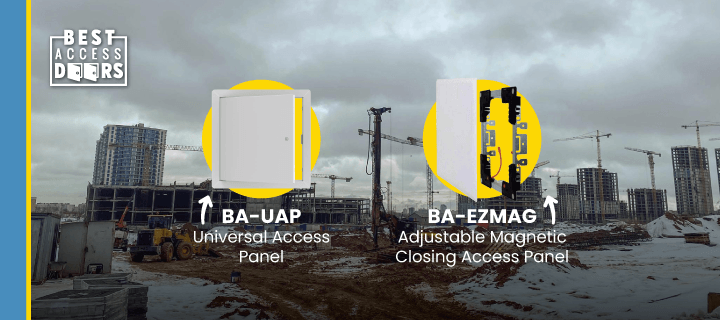
In this article, we’ll look at why construction bottlenecks spike in peak seasons and the top construction bottlenecks that appear during the busiest months. We’ll also discuss how the BA-UAP and BA-EZMAG can help prevent access-related delays in your construction projects.
Why Do Construction Bottlenecks Increase During Peak Building Seasons?
Construction bottlenecks increase during peak building seasons because labor, inspections, and materials all face rising demand at the same time, while overall industry capacity remains constrained.
When these conditions converge during the busiest months, normal project risk develops into significant construction schedule risk. This is especially so if details such as access panels, penetrations, and equipment clearances aren’t fully coordinated.
Proactive access panel planning helps your team avoid procurement delays, last-minute field modifications, and inspection delays. Explore our access doors and panels so you can standardize your access points before schedules tighten.
What Are the Top Construction Bottlenecks That Appear During the Busiest Months?
As mentioned, the top construction bottlenecks that appear during peak season are skilled labor shortages, inspection and permitting backlogs, material availability issues, weather-related site disruptions, and late-stage coordination gaps.
Let’s look at each bottleneck in detail.
1. Skilled Labor Shortages
ABC’s workforce model shows that the industry must bring in 499,000 new workers in 2026 to meet forecast demand. Under these conditions, adding more qualified crews on short notice is rarely feasible.
As a result, existing teams become stretched across projects because:
- Preferred subcontractors are scheduled on multiple projects at once.
- Productivity declines as crews move between sites and compress tasks.
While you can’t control national labor supply shortages, you can reduce avoidable disruptions by removing ambiguity from repeat details. Standardizing non-rated access panels allows you to install familiar products with fewer RFIs and less supervision.
2. Inspection and Permitting Backlogs
Inspection and permitting backlogs intensify during the peak season because authorities having jurisdiction (AHJs) and other regulatory agencies face their own workload surges while operating with fixed staffing and procedures.
A major part of this challenge is the time required to secure and maintain permits throughout a project's life. When many contractors submit applications at once, review queues grow longer, and approvals that would normally take weeks can stretch significantly. As a result, this delays both project starts and key milestones.
On top of that, your team must align with multiple layers of requirements, such as local building departments, state codes, and, in some cases, federal regulations. Keeping all these aligned requires careful planning, complete submittals, and ongoing communication with the agencies involved. Coordinating scopes, clearances, and equipment labeling makes it easier for inspectors to verify compliance. They can move through projects more efficiently, even when demand is high.
3. Material Availability Issues
Material availability becomes a significant constraint during peak construction months because prices and lead times are often influenced by external factors in addition to project demand.
Tariffs, regional instability, and other geopolitical uncertainties continue to put pressure on key materials, which increases some costs and extends delivery windows with little warning.
For your projects, that often means:
- Critical equipment or materials arriving later than the baseline schedule assumed.
- Partial shipments that force your crew to re-sequence work or leave areas incomplete.
- Substitutions chosen for cost or availability reasons that don’t match the original openings, clearances, or hardware assumptions.
To avoid this, you need to have proactive procurement strategies so you can manage procurement lead times, control costs, and prevent avoidable delays.
When your specifications also rely on a limited set of standardized, repeatable components, your team can place consolidated orders earlier, negotiate more effectively, and stage critical materials ahead of peak season. This reduces the likelihood of last-minute substitutions and field changes when material markets shift unexpectedly.
Related: How Can Contractors Navigate Material Cost Swings and Supply Chain Risks in 2026?
4. Weather-Related Site Disruptions
Weather-related site disruptions become a major bottleneck during the busiest months because heat, storms, flooding, wildfire smoke, and other severe conditions can slow crews, interrupt inspections, delay deliveries, and force work to be re-sequenced.
NOAA’s National Centers for Environmental Information reports that the U.S. experienced 27 billion-dollar weather and climate disaster events in 2024, while the most recent five-year average from 2020 to 2024 was 23 events per year.
On active projects, weather-related disruptions can create problems such as:
- Shortened workdays or delayed starts during extreme heat.
- Missed delivery windows because of storms, flooding, or regional disruptions.
- Delayed inspections when site conditions are unsafe or incomplete.
- Re-sequenced work when exterior openings, roof areas, or service zones are not ready.
You can reduce this bottleneck by building weather risk into your lookahead schedules, confirming delivery windows earlier, and coordinating access points before weather-sensitive phases begin.
5. Late-Stage Coordination Gaps
Poor initial planning, unrealistic scheduling, and late or incomplete design information remain among the primary causes of schedule overruns, along with supply chain disruptions.
On active projects, these issues manifest as:
- Non-specific notes such as “access panel by others” with no rating, size, or latch defined.
- MEP routing changes made after framing or drywall are in place.
- Valves, junction boxes, and controls installed without a defined access path.
Each unresolved issue generates RFIs and requires design attention at a time when design and project management teams are already heavily loaded.
Standardizing access panel models and details across your portfolio can significantly reduce the number of access-related RFIs.
You can join our Pro Club if you’re running multiple projects and want more predictable pricing and support for your access solutions. Pro Club members get dedicated account assistance and streamlined ordering that helps keep material availability from becoming a scheduling risk.
How Do BA-UAP and BA-EZMAG Help Prevent Access-Related Delays?
The BA-UAP Universal Access Panel and EZMAG™ Adjustable Magnetic Closing Access Panel help prevent access-related delays by providing standardized, maintenance-oriented solutions for non-rated openings.
Let’s look at each panel in detail.
BA-UAP Universal Access Panel
The BA-UAP access panel is designed for non-rated walls and ceilings where you need reliable, repeatable access to utilities, plumbing, and electrical systems.
Key features that make BA-UAP ideal for commercial projects include:
- Universal application: BA-UAP can be used across multiple commercial project types and phases as a standard non-rated panel in drywall or masonry construction.
- Durable construction: Manufactured from 16-gauge cold-rolled steel, BA-UAP is built to withstand regular use. A hidden pin hinge supports everyday operation, while doors over 24" in height or width use a continuous piano hinge to help prevent sagging and warping over time.
- Reliable, secure latching: The standard screwdriver-operated cam latch provides smooth, consistent operation. Optional key-operated cylinder cam latches, hex head and pinned hex head cam latches, mortise preparation for cylinders, and handle-operated cam latches allow you to match security and user requirements.
- Clean, finish-ready design: A 1" exposed flange and a high-quality white powder coat primer offer a uniform, paintable surface that aligns well with modern interiors and supports LEED-oriented specifications.
- Optional neoprene gasketing: Where tighter control of dust, drafts, or light moisture is needed, an optional neoprene gasket helps maintain envelope performance.
BA-EZMAG Adjustable Magnetic Closing Access Panel
The BA-EZMAG access panel is designed for conditions where opening sizes vary, existing framing is not perfectly uniform, or frequent access is expected after turnover.
Key features include:
- Adjustable frame for variable openings: EZMAG is available in three base sizes (6.5" x 8", 10.5" x 12", and 14" x 15.5"), each adjustable in 3/8" increments up to 1.5" in width and height. This range allows you to address a wide variety of square or rectangular openings without moving to fully custom fabrication.
- Magnetic closure in place of hinges: The 20-gauge cold-rolled steel door panel is held in place by four concealed magnets, one in each polymer corner. This design eliminates conventional hinges, simplifies installation, and reduces the risk of binding if surrounding assemblies move slightly.
- Versatile galvanized frame: A 24-gauge galvanized steel frame with notched knock-over or folding tabs adapts to walls and ceilings of varying thicknesses and allows crews to secure the panel efficiently.
- Finish-friendly concealed flange: The 5/16" concealed flange and white powder-coat primer support a clean appearance in finished interiors.
- Jobsite-ready packaging: EZMAG panels are preassembled, individually wrapped, and typically feature two security cables that prevent the door from falling when opened during service.
Ready to simplify access coordination on your busiest projects? Request a quote for BA-UAP or BA-EZMAG to standardize access details across your upcoming peak-season schedules.
Frequently Asked Questions about Challenges That Occur During Peak Construction Season
1. Which coordination issues most often delay projects during busy months?
The coordination issues that most often delay projects during busy months are poor initial planning, incomplete design information, and late decisions about details such as access locations, sizes, and hardware.
2. When should contractors plan for peak-season bottlenecks to protect schedules?
Contractors should start planning for peak-season bottlenecks in preconstruction, or, at the latest, a few months before they expect several projects to hit overlapping critical milestones. This gives enough time to adjust scopes, schedules, and procurement plans before labor, inspections, and materials are stretched thin.
3. How can standardized components reduce seasonal construction slowdowns?
Standardized components can reduce seasonal construction slowdowns and improve overall project coordination efficiency by making design, procurement, installation, and maintenance access more predictable across projects.
To Sum It Up
Challenges such as labor shortages, inspection backlogs, material availability, and late coordination remain central drivers of construction schedule risks.
By planning for these constraints in advance and standardizing components like access panels, you can reduce the number of avoidable delays that come from unclear or inconsistent design details.
Contact our team or call +1-888-327-5471 if you’d like support developing an access panel strategy that reduces delays during your busiest months.