
 Feedback
How Do Flush Access Panels Benefit Modern Commercial Interior Efficiency?
Posted by Best Access Doors on 17th Aug 2026
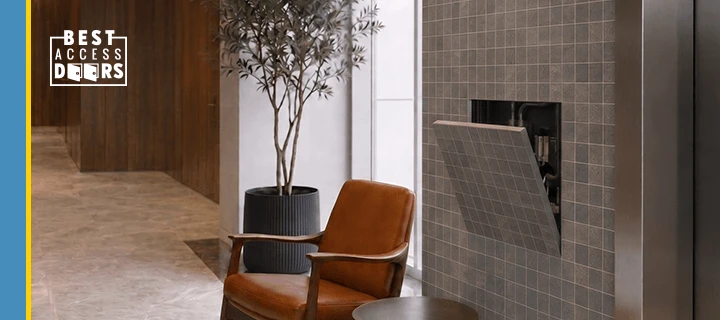
Flush access panels enhance the efficiency of modern commercial interiors by protecting finished surfaces and allowing maintenance teams to access services without damaging finishes or causing unnecessary disruption.
When access doors aren’t flush, sit proud of the wall, or ignore tile grids, they often lead to cracked grout, damaged drywall, and callbacks that drive up labor and extend schedules.
In this article, we’ll look at how access panels impact modern interiors, when to specify flush and tile-ready models, and how BA-IVT access panel supports clean fit-outs in modern commercial interiors.
Why Do Access Panels Impact Efficiency in Modern Commercial Interiors?
Access panels impact efficiency in modern commercial interiors because every opening you create on a wall or tiled surface can either support or undermine the quality and durability of the interior work around it.
If the panel doesn’t integrate with the tile layout or drywall-inlay construction, it becomes a recurring source of finish damage and rework rather than a clean, concealed service access point.
Flush-mounted access doors are designed to address these issues. They directly influence how well those openings perform by:
- Keeping frames aligned with drywall and tile planes to reduce accidental impact damage from carts and equipment.
- Maintaining tile alignment instead of forcing cuts that weaken corners to protect grout lines.
- Preserving finish tolerances so inspectors, owners, and tenants see continuous surfaces rather than “patched” or visibly altered areas around service points.
Explore our flush access panels to learn how concealed access doors can improve efficiency in modern commercial interiors.
When Should Flush Access Panels Be Specified to Maximize Project Efficiency?
You should specify flush access panels during schematic design, well before tile layouts and interior construction workflows are locked in.
When these decisions happen too late, they often trigger RFIs, field improvisation, and finish compromises that slow teams down.
To maximize efficiency, you should tie flush access panels into the project at three key points:
Schematic design and early coordination
- Identify zones that will require concealed service access (valves, cleanouts, junction boxes, controls).
- Decide where you can use flush-mounted access doors without clashing with feature walls or specialty finishes.
- Note these assumptions in your basis-of-design and early interior finish narratives.
Design development and shop drawing stage
- Lock in model types (for example, BA-IVT for tiled walls in washrooms, back-of-house corridors, and healthcare interiors).
- Coordinate exact sizes with the tile module dimensions and joint gaps, so the panel aligns with the grid rather than cutting tiles arbitrarily.
- Document installation sequencing requirements. For instance, when the panel framing goes in, when drywall inlay is installed, and how tilers should tie into the reveal.
Preconstruction and construction planning
- Include access panel locations and types in coordination meetings with drywall contractors, tile installers, and MEP trades.
- Use clear details to reduce RFIs and “field-engineered” solutions that don’t protect grout lines or drywall edges.
- Confirm that procurement timelines for specialty panels won’t delay rough-in or tiling.
How Do Flush and Tile-Ready Access Panels Reduce Drywall and Tile Rework?
Flush and tile-ready access panels reduce drywall and tile rework since the complex detailing is built into the frame, so crews don’t have to solve it on site with cuts and patches.
Flush access panels sit nearly level with the surrounding drywall, creating a clean transition between the frame and wall surface. This reduces the amount of filling, feathering, and sanding needed around the opening, helping installers achieve a consistent finish with less rework.
In tiled commercial interiors, cracked grout around access points comes from inconsistent substrates and missing movement joints rather than grout quality itself.
Tile experts note that subfloor or substrate movement, missing flexible joints at changes of plane, and structural flex often show up as cracks that mirror framing or joints. When you improvise an access opening through tile and drywall, you often introduce exactly those conditions.
Tile-ready access panels designed for inlay construction help prevent that by:
- Aligning to tile grids.
- Providing a stable drywall inlay construction.
- Maintaining consistent finish tolerances.
- Minimizing destructive access for maintenance.
Related: Which Access Doors and Panels Are Best Suited to Architectural Settings?
How Does BA-IVT Support Clean and Efficient Commercial Fit-Outs?
The BA-IVT Drywall Access Panel for Tiling supports clean and efficient commercial fit-outs by combining a flush, tile-ready profile with a robust aluminum frame and concealed hardware that provides the service access you need while keeping walls looking like a continuous tile.
Let’s look at its key features in detail.
Designed Specifically for Tiling Applications
The BA-IVT access panel is part of Best Access Doors’ InvisaHatch Series and is designed for tiling applications. Its key construction details include:
- Welded aluminum outer and inner frame assemblies, bonded with a special welding process for rigidity.
- Availability with 1/2" (12.7 mm) or 5/8" (15.9 mm) drywall inlay, so the door face matches common wall assemblies.
- A solid aluminum frame that resists warping and helps maintain finish tolerances around the opening.
- A reveal of approximately 1/8" (3 mm) between the outer frame and door hatch, giving a crisp shadow line without visual bulk.
Concealed Access for High-Visibility Interiors
BA-IVT is engineered for flush installation in walls, so the finished door sits nearly level with the surrounding tile.
Concealed snap locks and touch latches open the access panel when you press the spring-loaded latch side. There are no exposed hinges or knobs interrupting the tile pattern, just a minimal reveal that blends into the interior.
For security and project-specific requirements, you can order BA-IVT with alternative latching options, such as:
- Screwdriver-operated cam latch
- Round cylinder lock with key
- Hex head cam latch
- Pinned hex head cam latch
For panels above 12" x 12" (305 mm x 305 mm), BA-IVT includes a safety system to help prevent accidental opening when the panel is removed. However, the safety system must be reattached whenever the hatch is removed to reduce the risk of panels being mishandled or dropped during maintenance.
Supports Multiple Board Options and Wet-Area Strategies
To match different interior assemblies, BA-IVT is available in:
- Moisture-resistant green board.
- Mildew-resistant board.
- Cement board configurations.
This lets you coordinate the panel with substrates commonly used in restrooms, back-of-house wet areas, and other moisture-prone zones.
Ready to align access detailing with your tile and drywall specifications? Request a quote for BA-IVT to review sizes and options with our team.
Ordering in bulk? Join the Best Access Doors Pro Club for priority quotes, expedited order processing, and dedicated support when coordinating access panels for upcoming projects.
Frequently Asked Questions on Interior Construction Workflows
1. What installation sequencing steps improve interior workflow?
Coordinate access panels before drywall and tile installation. Frame the opening during rough-in, install the panel before finishing, and align tile joints with the panel reveal. After tiling and grouting, test the door and reattach any safety components. Early coordination helps prevent tile cuts, finish repairs, and access conflicts.
2. Will a flush tile access panel weaken the wall or cause grout to crack?
A properly installed flush tile access panel will not inherently weaken the wall or cause grout to crack. Most grout cracking issues are linked to movement, inadequate substrate support, or missing flexible joints, not the presence of an access door.
If the wall is built correctly and the panel is integrated into the assembly, grout and tile around the panel should perform similarly to the rest of the wall.
3. Is it better to retrofit an access panel into existing tile or plan a tile-ready panel from the start?
It’s always better to plan a tile-ready panel from the start. Retrofitting an opening into existing tile often requires:
- Cutting grout and tile with oscillating tools or grinders.
- Risking cracked or destroyed tiles that may be hard to match.
- Building a makeshift door or installing a surface-mounted plastic panel that doesn’t match the finish.
To Sum It Up
Flush access panels improve the efficiency of modern commercial interiors by protecting high-visibility finishes and reducing avoidable rework.
The BA-IVT access panel is designed specifically for tiled walls, with welded aluminum construction, drywall inlay options, a tight reveal, concealed snap locks, and safety features that support repeated use. These details help you maintain clean commercial finishes while still providing the concealed service access your clients need over the life of the building.
If you’re coordinating an upcoming commercial interior project, contact our team or call +1-888-327-5471 to plan flush access panel solutions that keep your finishes clean and your workflows efficient.