
 Feedback
What Access Panels Are Used in High-Traffic Commercial Areas?
Posted by Best Access Doors on 3rd Aug 2026
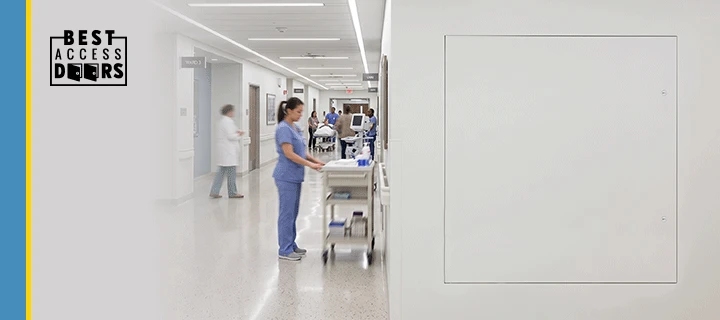
Access panels used in high-traffic commercial areas include flush drywall panels, fire-rated access doors, security-focused panels, and specialty oversized units. Each panel is suited to specific locations, assembly types, and access frequencies, and choosing the right one is crucial in these environments.
Access doors in commercial buildings are opened frequently by maintenance teams, inspectors, and facility staff. As a result, substandard construction or poor hardware choices on a panel that gets this much use can translate directly into repeated repairs, damaged finishes, and compliance gaps.
In this article, we'll cover what makes a panel suitable for high-traffic commercial use, how requirements differ across building types, and which panel types to consider. We’ll also look at how the right specification can improve long-term operational performance.
What Makes an Access Panel Suitable for High-Traffic Commercial Environments?
Commercial access panels are suitable for high-traffic environments when they combine heavy-gauge construction, reliable latching hardware, a flush finished profile, and low maintenance requirements.
Each of these factors directly affects how the panel performs under repeated use and how much it costs to maintain over its service life.
With that in mind, here are the core criteria to evaluate:
- Material and gauge: Heavy gauge steel, e.g., 16-gauge cold rolled or galvanized steel, is the common choice for durability in commercial interiors, especially in corridors, mechanical rooms, and service areas where carts and equipment pass frequently.
- Latch and lock type: For locations that prioritize security, key-operated locks may be ideal, while other areas that prioritize quick access may benefit from self-latching slam latches that close securely without manual engagement.
- Flush or low-profile installation: A flush panel design integrates cleanly into drywall and is less prone to damage from incidental contact.
- Finish durability: A high-quality powder coat primer or a stainless finish can withstand cleaning agents better than bare steel or thin paint, which reduces touch-up cycles in occupied buildings.
- Life cycle cost: A heavier-gauge panel might cost more upfront but will save money over a 10-year maintenance window since it needs less hardware replacement and drywall patching.
Ready to specify the right access panel for your project? Browse our full range of commercial access doors and panels, including drywall, fire-rated, and security options for every commercial application.
How Do Access Panel Requirements Vary Across Commercial Settings?
Access panel requirements for high-traffic buildings vary significantly based on the location. For example, the performance criteria for a hospital corridor will be entirely different from those of a school or a transportation hub.
Let’s look at each environment in detail.
Hospitals and Healthcare Facilities
Healthcare facilities demand access panels that are hygienic, tamper-resistant, and compatible with frequent cleaning.
Panels with smooth, painted surfaces that have no exposed fasteners or crevices reduce the risk of bacterial accumulation. In addition, key-operated locks on mechanical rooms and electrical risers restrict unauthorized access.
Schools and Educational Buildings
Educational buildings are high-traffic environments with a mix of supervised and unsupervised spaces. As a result, student-accessible areas need durable access doors that can withstand deliberate and incidental contact without deforming.
Office Buildings and Retail Spaces
In commercial offices and retail environments, aesthetics matter as much as function. Panels in public-facing or tenant-occupied areas must be flush with the finished wall to preserve the interior design intent.
Hospitality Properties
Hotels and hospitality venues have strict appearance standards in guest-accessible areas. This means access panels in corridors, lobbies, and guest rooms must be nearly invisible after installation.
Transportation and Industrial Facilities
Airports, transit hubs, and industrial buildings operate around the clock with constant traffic. This exposes access panels to the highest physical and security demands in any commercial setting.
As a result, heavy-gauge steel panels with continuous piano hinges and deadbolt or key-operated cam latches are appropriate for these environments.
What Types of Access Panels Are Used in High-Traffic Commercial Buildings?
High-traffic commercial buildings use several access panel types depending on the wall or ceiling assembly, fire rating requirements, security needs, and the size of the building system behind the panel.
Let’s look at each panel type in detail.
Flush Access Panels
Flush drywall panels are appropriate for non-rated assemblies where the primary requirement is clean appearance combined with reliable access for plumbing, electrical, and HVAC systems.
These panels install directly into drywall wall and ceiling assemblies, with a mud-in flange that allows drywall compound to be finished directly over the frame for a flush, nearly invisible result.
Fire-Rated Access Doors
Fire-rated access doors are required wherever a panel penetrates a fire-rated wall or ceiling assembly.
The International Building Code (IBC) determines where fire-rated assemblies are required by wall or occupancy type, while NFPA 80 defines how those assemblies must be constructed and maintained.
In practice, this means checking the wall's fire rating before specifying a panel, since installing a non-rated panel in a rated wall voids the assembly and creates a code violation.
Related: Why There’s a Growing Need for Fire-Rated and Insulated Panels in Large-Scale Projects
Security-Focused Access Panels
Server rooms, electrical rooms, rooftop equipment, and pharmaceutical storage areas require access panels with restricted access controls.
Options like key-operated cylinder cam latches, mortise deadbolt locks, and ring-operated slam latches prevent unauthorized entry while still allowing fast access for authorized personnel.
Specialty and Oversized Panels
Large HVAC units, sprinkler risers, pipe manifolds, and electrical switch gears often require access openings that exceed standard panel sizes.
Double-leaf designs solve this by allowing wider openings within a single panel frame, eliminating the need for multiple adjacent panels.
Custom sizes also address the same issue from a different angle. They let panels be built to the exact dimensions that mechanical rooms, data centers, and large commercial kitchens require, even when those spaces don't conform to standard module sizes.
How Do Correctly Specified Access Panels Improve Commercial Building Operations?
Correctly specified access panels reduce maintenance downtime, protect building finishes, and lower long-term labor costs.
These benefits show up most clearly in two areas of day-to-day building operations:
- Maintenance efficiency: A panel that opens quickly and reliably without additional tools saves technicians time on every service call. Across a building with dozens of access points, those small-time savings can compound over a year of service calls.
- Finish protection: Panels that fit poorly can cause recurring damage to adjacent drywall, paint, or tile. Every repair cycle incurs labor and material costs and, in occupied buildings, also causes disruption. A flush-mounted, properly flanged panel installed the first time correctly eliminates most of these issues.
Is the BA-LO1D-DF a Good Option for Large Commercial Drywall Applications?
The BA-LO1D-DF Large Opening Access Panel with Mud-In Flange is appropriate for non-rated drywall assemblies in hospitals, office buildings, hotels, schools, and any commercial environment where the system behind the wall requires a wider-than-standard access opening.
Here’s what makes it the right choice for large, high-traffic commercial drywall applications:
- Double-leaf design for large openings: The BA-LO1D-DF uses a double-leaf door configuration, which provides a wide access opening within a single panel frame. This is particularly important in mechanical rooms and large commercial interiors where the building system demands a wider clear opening than a single-leaf panel can provide.
- 16-gauge cold-rolled steel construction: The 16-gauge body offers the structural durability required for high-traffic commercial environments.
- Mud-in flange for a finished wall appearance: The mud-in flange allows drywall compound to be applied over the frame perimeter during finishing, which eliminates the visible edge line and produces a seamless finish.
- Self-latching slam latch with inside panel release: The self-latching mechanism closes securely on contact, removing the need for manual latch engagement each time the panel is closed.
- Custom sizes available. The BA-LO1D-DF is available in custom sizes to accommodate non-standard openings. This eliminates the need for field modifications that compromise the finished appearance.
Sourcing panels for a large commercial drywall application? Request a quote for the BA-LO1D-DF or a similar solution, and our team will help you select the right panel for your project.
If you also specify or procure access panels across multiple commercial projects, joining our Pro Club will grant you access to perks like priority quote turnaround, expedited order processing, and preferred shipping rates.
FAQs on Access Panels for High-Traffic Areas
1. When should you choose a double-leaf access panel over two separate single-leaf panels?
A double-leaf access panel is the better choice when you need a wide, clear opening but want to keep the wall penetration contained within a single frame.
Two separate single-leaf panels installed side by side require independent framing for each unit. As a result, they produce two visible frame lines on the finished wall and introduce twice as many latches and hinges to maintain. A single double-leaf frame eliminates that complexity.
2. Do access panels in commercial buildings need to be fire-rated?
Access panels require a fire rating only when they penetrate a fire-rated wall or ceiling assembly. Always confirm the rating of the host assembly with the code documentation before specifying a panel type.
3. Can access panels in high-traffic commercial areas be finished to match the surrounding wall?
Yes. Panels with a mud-in flange can be finished flush with the surrounding drywall surface. The flange receives drywall compound during the finishing phase, allowing the perimeter edge to be feathered into the wall and painted over with the same finish coat. The result is a panel face that is visible only at the gap between the door leaf and the frame.
To Sum It Up
Selecting access panels for high-traffic commercial environments is a specification decision with real operational consequences.
The right access solution reduces maintenance costs, protects finishes, and keeps the building compliant across its service life. The wrong panel does the opposite, quietly accumulating repair costs and maintenance delays until replacement is the only option.
Not sure which panel is right for your project? Contact us or call +1-888-327-5471. Our team will help you identify the right product for the location, assembly type, and access frequency your project demands.