
 Feedback
High-Security vs Fire-Rated Access Panels in Data Centers: What Is the Difference?
Posted by Best Access Doors on 14th Oct 2026
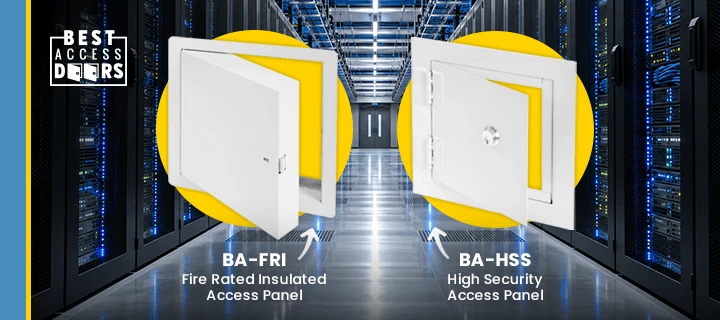
The difference between high-security and fire-rated access panels comes down to their intended performance. A high-security access panel helps protect restricted data center infrastructure from unauthorized access or tampering. Meanwhile, a fire-rated panel is evaluated to help maintain the assembly's fire rating. They are not interchangeable.
When a data center location requires both controlled access and fire-rated performance, the project team should evaluate a fire-rated security access panel that meets both requirements.
What Is the Main Difference Between High-Security and Fire-Rated Access Panels?
Security and fire rating address different risks within a data center. A high-security access panel helps control who can reach sensitive equipment, utilities, or restricted spaces. Depending on the product and project requirements, it may use heavy-gauge steel, a reinforced frame, heavy-duty hinges, and specialized locking hardware to discourage tampering or unauthorized entry.
A fire-rated access panel serves a different purpose. It is evaluated for installation in a rated wall or ceiling assembly under specified conditions. Its construction, insulation, closing and latching features, allowable sizes, and installation method must correspond with the applicable listing and project requirements.
For example, an access panel leading to network controls or electrical distribution equipment may require reinforced construction and specialized locking hardware. A panel installed in a rated corridor wall may require fire-rated performance even when the space behind it is not highly restricted. These locations may look similar from the outside, but they address different project risks.
The confusion arises because both products can look substantial. A heavy-duty security panel and an insulated fire-rated panel may appear similarly robust, but appearance and weight do not establish their performance. A high-security panel is not automatically fire-rated, and a listed fire-rated panel does not automatically provide the construction or locking features required for a security-sensitive location.
Choosing by appearance rather than documented performance can leave one requirement satisfied while the other remains unaddressed.
| Comparison Point | High-Security Access Panel | Fire-Rated Access Panel |
|---|---|---|
| Primary purpose | Control access and discourage tampering or unauthorized entry | Provide access through an assembly that must maintain a specified fire rating |
| Requirement established by | Project security plan, access-control requirements, and specifications | Rated assembly, project documents, applicable codes and listings, and authority having jurisdiction |
| Typical features | Heavy-duty construction, reinforced frame, robust hinges, and specialized locking options | Insulated or rated construction, closing and latching features, and installation requirements established by the listing |
| Potential locations | Restricted electrical, controls, communications, or service areas | Fire-rated walls, ceilings, shafts, or service areas |
| Potential BEST starting point | BA-HSS | BA-FRI |
These models are starting points for technical review, not universal recommendations. Confirm the construction type, assembly rating, size, installation method, security requirements, hardware, and current product documentation before specifying a model.
When Does a Data Center Need a High-Security Access Panel?
A high-security access panel is the right starting point when the space behind an opening is sensitive and must be protected from tampering or unauthorized entry. In a data center, this can include secure electrical rooms, control spaces, communications areas, and wall or ceiling openings that provide access to a restricted area.
The test is simple: If someone getting through the opening would gain access to equipment, systems, or areas that must be controlled, the opening needs a security panel. The panel’s construction and locking hardware should then match the sensitivity of what it protects.
For restricted openings in non-rated assemblies, BEST’s BA-HSS high-security access panel is designed for high-security access. It is built with detention-grade materials, including a heavy-gauge steel door, an angle frame, and heavy-duty butt hinges. Available mortise preparation and deadbolt configurations allow the locking hardware to be coordinated with the project’s security requirements.
When Does a Data Center Need a Fire-Rated Access Panel?
A fire-rated panel is required whenever the opening sits in an assembly that must maintain a specified fire rating. Rated walls, ceilings, and shafts are common throughout a data center because they separate fire compartments and protect egress and critical infrastructure.
BEST's BA-FRI is a fire-rated, insulated access door certified to UL standards for rated walls and ceilings, with mineral-wool insulation and self-latching operation that meets recognized fire-safety requirements. If the drawings show a rating on the assembly, the panel in it has to be rated to match, or the barrier is compromised at that point.
What If a Data Center Opening Requires Both Security and a Fire Rating?
Some spaces are both rated and restricted, such as a fire-rated electrical or controls room that also requires controlled access. In that case, the panel must be reviewed against both requirements together, and a single-purpose panel will not suffice.
For an opening that requires both fire-rated performance and controlled access, the BA-FRI-HS fire-rated security access panel is one option to consider. Its fire-rated construction includes two inches of mineral-wool insulation, while available mortise and detention-grade locking hardware configurations provide higher-security locking options. Before specifying it, confirm that its rating, approved assembly application, size limits, installation method, and selected hardware meet the project requirements.
Planning for this combination early is important because adding a rating or security to an installed single-purpose panel usually means replacing it and repairing the surrounding construction. On a mission-critical build, that is exactly the kind of rework that should be addressed before installation.
Frequently Asked Questions
1. Is a high-security access panel the same as a fire-rated access panel?
No. Security and fire rating address different project requirements. A high-security access panel focuses on controlled or tamper-resistant access, while a fire-rated access panel is evaluated for use in a rated assembly. A panel can be one, the other, or both.
2. What if a data center requires both security and a fire rating?
Where both conditions apply, the access solution must be reviewed against both requirements. A model such as BA-FRI-HS may be a starting point for technical review, where rated construction and controlled access must be considered together. Confirm the assembly rating and the security requirement before selecting.
3. How do I know which requirement applies to a given opening?
Check the assembly first. If the wall or ceiling must maintain a fire rating, a rated panel is required. If the space is restricted or sensitive, controlled access is required. Where the drawings and specifications call for both, plan for a combined solution from the start.
How Should the Panel be Matched to the Requirement?
Matching the panel to the requirement begins with determining whether the opening needs security, fire-rated performance, or both. The correct choice is not necessarily the model with the most features, but the one whose documented performance matches the identified conditions.
Confirm both requirements against the project drawings and specifications, then evaluate the selected model using the current manufacturer documentation. This keeps the specification defensible and helps avoid paying for performance the opening does not need or overlooking performance it requires.
Next step: Check out our Data Centers page and explore access solutions for high-security applications and fire-rated assemblies. You can also request a Data Center Access Match to identify potential models for technical review.