
 Feedback
How Data Center Expansion Is Reshaping Access Panel Requirements in Mission-Critical Builds
Posted by Best Access Doors on 22nd Jun 2026
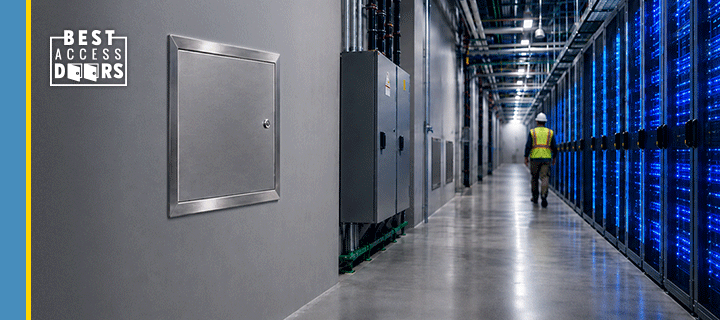
Data center expansion is not just adding more buildings, it is raising the bar for how access is planned inside them. As power, cooling, controls and utility infrastructure become denser, a single access panel can no longer represent a whole facility's access strategy. Different areas of the same data center require different access solutions, and specifying by the condition at each opening is what keeps mission-critical builds serviceable, compliant and secure.
Why is data center expansion changing access panel requirements?
Mission-critical facilities are being built denser and more heavily serviced than ever. More electrical distribution, more cooling capacity, more controls and more supporting infrastructure all mean more systems that must remain reachable for inspection, maintenance and future upgrades. Each of those systems sits in its own construction, with its own fire rating, security level, loading and exposure. That is why the old habit of picking one favorite access panel and repeating it across a project no longer holds up. The building has outgrown the one-panel approach.
For contractors, specifiers and facility teams, the practical shift is simple to state and important to apply: start from the opening, not from a default product. Confirm what the assembly around the opening has to do, then choose the access solution that meets that specific condition.
Does one access panel work across an entire data center?
No, and this is the core correction for anyone still thinking in terms of a single product. A data center contains restricted electrical rooms, fire-rated compartments, general service areas, rooftop mechanical decks and under-floor utility routes. Those are fundamentally different access problems. A panel that is right for a clean, non-rated service wall is the wrong choice for a rated compartment or a secure room, and a floor or roof opening needs a product built for load or weather that a wall panel was never designed to handle.
Thinking area by area, rather than product by product, is what separates a coordinated access strategy from a collection of mismatched openings. The sections below map the main zones of a data center to the type of access each one calls for.
Where does the BA-UAP-SS panel actually fit?
The BA-UAP-SS Universal Access Panel in Stainless Steel is a strong choice for non-rated support and service applications, and that is exactly where it belongs in a data center. Made from 16-gauge 304 stainless steel with a flush design and a screwdriver-operated cam latch, it suits clean, hygienic or corrosion-sensitive service openings in non-rated walls and ceilings, the kind of general access points that need durability and a tidy finish without a fire rating or high-security hardware.
What the BA-UAP-SS is not is a universal answer for the whole facility. It is a non-rated general and service panel, available in a standard steel version (BA-UAP) as well. It does not replace a fire-rated panel in a rated assembly, a high-security panel on a restricted room, or a floor or roof hatch built for load and exposure. Positioned correctly, around appropriate non-rated support and service applications, it is a dependable part of a broader access strategy rather than the strategy itself.
What access solutions do the other areas of a data center need?
Different zones call for different products. The table below summarizes how the main data center areas map to access categories, with each recommendation treated as a starting point for technical review rather than a fixed answer. Each model links to its product page.
| Data center area | Access condition | Potential starting point |
|---|---|---|
| Restricted electrical / controls rooms | Controlled, tamper-resistant access | BA-HSS, BA-PHS |
| Fire-rated compartments and shafts | Maintain the assembly's fire rating | BA-FRI |
| Rated + restricted openings | Both fire rating and controlled access | BA-FRI-HS, BA-PFI-HS |
| General MEP / service areas | Non-rated service access (clean/hygienic) | BA-UAP, BA-UAP-SS |
| Rooftop cooling / mechanical | Safe, weatherproof roof access | Equipment / thermally broken roof hatch |
| Under-floor utilities and cabling | Rated or general floor access | BA-FRFD, BA-AFL, BA-WTFD-H20 |
Starting points for technical review only. Final selection depends on codes, ratings, construction type, dimensions, loading, exposure and hardware.
How should security and fire-rated access be handled?
Restricted spaces such as secure electrical and controls rooms need controlled access, which points to a high-security panel like the detention-grade BA-HSS or the flush BA-PHS, whose product page specifically names server rooms and data centers. Fire-rated compartments need a panel that helps maintain the rating of the assembly, which points to a fire-rated insulated panel such as BA-FRI. Where an opening is both rated and restricted, a combined fire-rated security model such as BA-FRI-HS or BA-PFI-HS may be the starting point. The requirement always follows the assembly and the sensitivity of the space, not the building label.
What about MEP, roof, and floor access?
MEP and cooling systems run throughout the facility and need coordinated service access, matched to whether each opening is rated, restricted or general. Rooftop cooling equipment needs a roof hatch sized for moving tools and parts and detailed into the roof for weather and thermal performance. Under-floor routes that carry power, cabling and cooling need floor access matched to loading and exposure, from a rated floor hatch like BA-FRFD to a general aluminum hatch like BA-AFL or a watertight, traffic-rated BA-WTFD-H20 where water or heavy loads are present.
Why does BIM coordination matter for data center access?
Because data centers are so densely coordinated, access is best planned in the model rather than discovered in the field. Including access doors and panels in BIM coordination lets teams confirm openings, ratings and service routes before construction, which avoids cutting into finished, rated or secured work later. Many BEST access models publish BIM and Revit content so specifiers can place the actual component in the model and resolve clashes early.
Frequently Asked Questions
Can one access panel cover an entire data center?
No. A data center has multiple access conditions across walls, ceilings, roofs and floors, including secure, fire-rated, general service, roof and floor or utility access. Each condition can require a different product, so access should be specified by the opening rather than by a single panel.
Where is a stainless steel universal access panel the right choice?
A stainless steel universal panel such as the BA-UAP-SS suits non-rated support and service openings, especially clean, hygienic or corrosion-sensitive areas. It is not a substitute for a fire-rated, high-security, roof or floor product where those conditions apply.
Do data center access panels need to be fire-rated?
Only where the opening sits in an assembly that must maintain a fire rating. Rated compartments require a fire-rated panel such as the BA-FRI, while non-rated service areas do not. Confirm the assembly before selecting.
How do I choose the right access solution for a specific area?
Confirm the location, the surrounding construction and any required rating, the security requirement, the system needing access, and any loading or exposure. Those conditions point to the right category and model. Treat any recommendation as a starting point for technical review.
How should teams approach data center access going forward?
As data centers keep expanding, the projects that plan access area by area, matched to condition, will avoid the most costly rework and keep their facilities serviceable and compliant. A stainless steel universal panel like the BA-UAP-SS has a clear and valuable place in that plan, around non-rated support and service openings, but it is one part of a facility-wide strategy rather than the whole of it. BEST helps project teams plan the right access solution for every area of a data center.
Next step: Request a quote for your data center project, and our product experts can help identify the right access solution for each area of the facility.