
 Feedback
What Size Access Panel Do I Need for Commercial HVAC & MEP Rooms?
Posted by Best Access Doors on 2nd Jul 2026
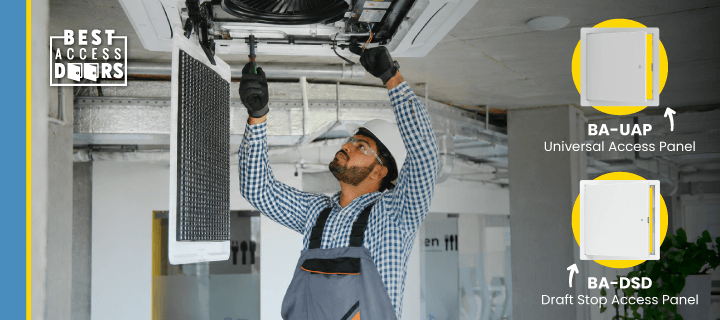
For most commercial HVAC and MEP rooms, 20" x 30" is the minimum clear opening for equipment access, and you should increase the size based on the equipment service clearance and the largest component that may need to be removed.
The International Mechanical Code (IMC) uses this standard as a baseline for servicing appliances in concealed spaces. This ensures that access openings support safe, code-compliant service over the life of the building.
In this article, we’ll explain why access panel size matters in HVAC and MEP rooms, when to lock in dimensions during MEP coordination, and how to size the BA-UAP and BA-DSD for different commercial applications.
Why Is Access Panel Size Critical in Commercial HVAC and MEP Rooms?
Access panel size is critical because it determines whether technicians can inspect, service, and replace HVAC and MEP equipment without cutting into finished walls and ceilings or violating code-required working space.
IMC Section 306.1 requires appliances and HVAC components to have access for inspection, service, repair, and replacement with a level working space of at least 30" deep and 30" wide at the front or service side.
This means your access panel must be large enough and located where technicians can use the 30" x 30" working space to reach and work on the equipment safely.
Related: What Are the Emerging Standards & Codes Shaping Access Panel Requirements in 2026?
Which Mechanical Room Access Requirements Determine MEP Room Access Panel Sizes?
The requirements that determine access panel sizes in MEP rooms are code-required working space, equipment service clearances, and the need to remove the largest component behind the panel.
IMC Section 306.3, which covers appliances in concealed spaces like attics, calls for an opening and passageway large enough to remove the largest appliance. It also sets a minimum access opening of 20" x 30" as the baseline.
For your access panel sizing, that means you should:
- Start from code-driven baselines.
- Use 20" x 30" as the minimum clear opening wherever the panel is intended to provide equipment access, then confirm whether a larger opening is needed based on specific appliances or assembly.
- Confirm that you have a 30" x 30" working space immediately inside or in front of the opening on the service side.
- Check the manufacturer’s service clearances.
- Review the equipment data for coil pull, filter access, tube pull, and service-side clearances.
- Make sure the access panel location and size allow technicians to achieve those clearances from the opening.
- Consider how you’ll remove and replace the big components.
- Identify the largest pump, coil, fan section, valve manifold, or control assembly likely to be replaced.
- Ensure your access panel is wide and tall enough to maneuver that component through without demolishing finishes.
Check out our HVAC access doors to compare panel options and align sizes with your coordinated layouts.
When Should Commercial HVAC Access Door Sizing Be Finalized During MEP Coordination?
You should finalize access panel sizing during MEP and BIM coordination to resolve conflicts among building systems before framing and drywall are installed.
If you wait until after walls are framed to decide panel sizes, you risk blocking service zones with studs, conduits, or ductwork and ending up with undersized openings squeezed into leftover wall space.
To avoid this, a practical sequence to follow should be:
- During coordination, mark service zones on walls and ceilings for each major piece of HVAC and MEP equipment.
- Assign access panel locations and preliminary sizes to those zones, starting with 20" x 30" and adjusting as needed to match equipment and working-space layouts.
- Make sure no ducts, pipes, conduits, or other systems pass through the area where the panel will go and confirm that its location provides the IMC-required working space at the service side of the equipment.
- Lock these sizes into both mechanical and architectural drawings before they’re issued for construction.
How Do Undersized Commercial Service Access Panels Create Inspection and Maintenance Problems?
Undersized access panels undermine inspection readiness and maintenance because they violate the spirit of IMC access provisions and make required working space impossible to achieve.
Some common issues you’ll encounter when your panels are smaller than what the code expects include:
- Correction notices and re-inspections when inspectors cannot verify access for servicing or removal of major equipment.
- Field modifications, where crews cut around a small access panel to reach dampers, valves, or coils, and then have topatch the finishes.
- Deferred or skipped maintenance, because technicians cannot comfortably work through the opening and must choose between unsafe body positions and extra demolition.
How Can BA-UAP and BA-DSD Be Sized for Different HVAC and MEP Applications?
You can size BA-UAP Universal Access Panel and BA-DSD Draft Stop Access Panel by selecting standard or custom dimensions that meet the IMC-driven minimums. From there, you can scale up as needed to match each specific HVAC or MEP service task in your non-rated walls and ceilings.
Both models are built from 16-gauge cold-rolled steel with hinge designs that support larger openings, so you don’t have to compromise on durability when you increase panel size.
In terms of configuration, BA-UAP uses a flush design with a 1" exposed flange and a hot-rolled pin hinge (with a continuous piano hinge on sizes over 24").
BA-DSD, on the other hand, adds neoprene gasketing and heavy-duty construction that helps manage harsh environmental conditions and limit drafts at the opening.
You can order each panel with multiple latch options that let you standardize the hardware by room type and level of access control. The latch options include:
- Screwdriver-operated cam latches
- Key-operated cams
- Mortise prep
- Hex head cams
- Handle-operated cam latches
Now, let’s look at how you can size both panels based on your HVAC and MEP applications.
BA-UAP Universal Access Panel
Use the BA-UAP access panel as a universal access door for non-rated HVAC and MEP walls and ceilings where you need reliable, repeatable access.
Start with a 20" x 30" clear opening for equipment access, in line with IMC guidelines, then increase the size where manufacturer clearances, coil pulls, or large component removal paths demand more room.
Where a single opening needs to serve multiple devices, apply custom sizes so grouped valves, VAV boxes, or control panels sit behind one larger panel that supports IMC working-space intent.
BA-DSD Draft Stop Access Panel
Use the BA-DSD access door when you need a gasketed panel that controls drafts while still providing good access. For example, around ductwork, shafts, or in rooms where you want to limit air leakage through the opening.
Match the clear opening to the largest inspection or service task at that location. Start from 20" x 30" for equipment access and increase the size for larger mechanical assemblies or tight service conditions.
Here, you can take full advantage of BA-DSD’s standard neoprene gasket and robust construction to create tighter mechanical spaces with reduced air leakage at access points.
Request a quote for BA-UAP or BA-DSD sized to your HVAC and MEP service requirements. Our team will help you match panel sizes to your equipment clearances and mechanical layouts, so your access strategy aligns with code expectations and field realities.
Also, if your team is sourcing access doors across multiple projects, consider joining our Pro Club to enjoy exclusive deals and benefits available only to our members.
Frequently Asked Questions on Access Panel Sizes for HVAC and MEP Rooms
1. What is the purpose of an access panel?
The purpose of an access panel is to provide a convenient opening in a wall or ceiling so technicians can reach hidden mechanical, electrical, or plumbing components without demolishing finished walls or ceilings.
2. Are access panels required by code?
Access panels themselves are not always named directly in the code. However, the International Mechanical Code (IMC) and International Building Code (IBC) both require that appliances, equipment, and certain devices be accessible for inspection, service, repair, and replacement. In many situations, the only way to meet those accessibility requirements is to provide an appropriately sized access panel.
3. Can I use smaller panels for simple inspection-only tasks?
You can use smaller panels for simple inspection points where you’re not accessing an appliance. But once a panel is needed to reach an appliance or a major HVAC/MEP component, it’s better to treat 20" x 30" as your starting point and increase the size from there as needed.
To Sum It Up
The access panel size you choose for commercial HVAC and MEP rooms should always support code-aligned working space and maintenance access planning.
When you lock in access panel sizes during MEP coordination and use IMC and IBC codes as your guide, you’ll be able to cut down on rework and avoid inspection surprises. You’ll also hand over commercial mechanical spaces that are easy to service for the long term.
If you’d like help choosing access panel sizes for your next commercial project, our team is ready to walk you through the details. Contact us or call +1-888-327-5471 to speak with our specialists so you can get personalized recommendations.