
 Feedback
How to Review an Access Door Schedule Before Procurement
Posted by Best Access Doors on 16th Oct 2026
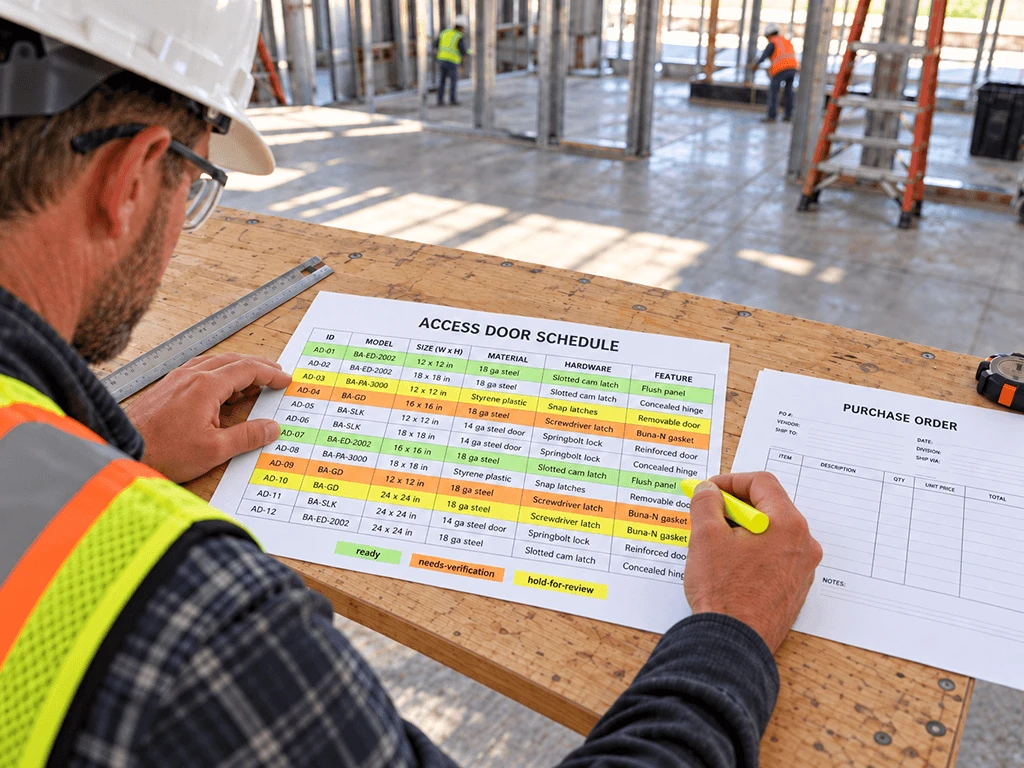
An access door schedule can be complete and still be wrong to buy from. The procurement question is not whether every row has a model number. It is whether the scheduled configuration matches the real opening, service task, finish, rating, and approved documents.
A mismatch discovered after installation means reordering, reframing, or rework at a cost and schedule impact that a proper review would have prevented. A proper access door schedule review would catch those mismatches before purchase, not after installation.
Run a Red-Yellow-Green Schedule Audit
For a proper review, start with a triage pass across the full schedule. Group every row into one of three categories before reviewing individual tags in detail.
| Status | Typical condition | Action |
|---|---|---|
| Green | Standard non-rated opening; model/size/finish match documents | Confirm quantity and lead time |
| Yellow | Custom size, unusual finish, special lock, ceiling condition, exterior exposure | Verify model-specific data and approvals before release |
| Red | Rated condition unresolved, field opening differs, substitution pending, equipment path unknown | Hold procurement until discrepancy is closed |
The schedule audit gives your team a clear picture of which rows are ready, which need verification, and which need to be resolved before any purchase order goes out.
Audit Function Before Model Number
For each tag, identify what the opening serves before checking whether the model is correct. NIH and WBDG maintainability guidance requires clear and safe access for servicing, removing, and replacing equipment.
If the access door specification schedule says 12" x 12" but the actual service task requires two-handed removal, the row won't be ready even if the model is available in that size.
Audit the Physical Condition
After auditing the function, work through each tag against these physical conditions before releasing any row for procurement:
- ☐ Tag appears on the correct drawing/location.
- ☐ Wall vs. ceiling vs. floor/roof is correct.
- ☐ Substrate and finish match the flange/recess.
- ☐ Clear opening is adequate for service and replacement.
- ☐ Rough opening matches the selected product.
- ☐ Rating/specialty features match the specification.
- ☐ Latch, lock, keying, and hinge are correct.
- ☐ Custom deviations are approved and documented.
- ☐ Quantity is totaled by configuration, not model family only.
- ☐ Lead time supports framing/close-in and delivery sequence.
Make the Quote Request Part of the Audit
For mixed commercial schedules, sending the supplier the opening list, size, location, rating, finish, and options can surface conflicts before purchase.
BEST's quote process is designed for standard and custom sizes, fire-rated, security, insulated, exterior, and bulk or multi-unit orders. If the schedule includes mixed, custom, rated, or high-volume openings, submit it as a project requirements package rather than requesting individual prices. Our team will review the full schedule, flag configuration conflicts, and confirm pricing against the actual conditions.
You can also use our Access Door Submittal Checklist to review product details, dimensions, ratings, finishes, and technical documents before submitting your access door package.
FAQs
1. When should an access door schedule be released for procurement?
An access door schedule should be released for procurement when the locations, service openings, substrates, ratings, sizes, options, substitutions, and supporting approvals are resolved enough that the supplier is not being asked to guess.
2. What is the fastest way to resolve a mixed or complex access door schedule?
Submit the full opening list to BEST with size, location, rating, finish, and any custom requirements. Reviewing the schedule as a complete package surfaces conflicts earlier and keeps access door procurement on track with the project timeline.
3. What is the most common mistake made when reviewing an access door schedule?
Treating model availability as readiness. A model being available in the right size does not mean the scheduled configuration is correct. The service task, substrate, rating, finish, and approved documents all need to match before a row is ready for procurement.
4. What should I do if the field opening differs from the dimension on the drawing?
Flag it as a red row and hold procurement on that tag until the actual field condition is measured and documented. Measure the actual condition, confirm the model and frame can accommodate it, and update the schedule before releasing that row.
5. What information should I give to the supplier when submitting a mixed schedule for a quote?
For each opening, provide the tag reference, wall or ceiling condition, substrate, nominal size, required clear opening, fire or specialty rating, finish, latch or hardware type, and any custom configuration or deviation. The more complete the information, the faster the supplier can identify conflicts and confirm pricing without returning for clarification.
Send Your Access Door Schedule for Review
Ready to move your project forward? Send us your schedule, drawings, or access door list. We’ll help identify missing information, product selection questions, and documentation needs before procurement.