
 Feedback
What Size Access Panel Is Needed for HVAC and ERV Systems in Commercial Buildings?
Posted by Best Access Doors on 8th Jun 2026
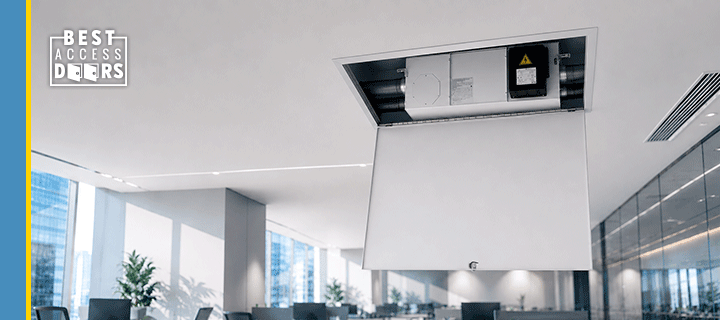
The right access panel for HVAC and ERV systems in commercial buildings is the one that matches the equipment's service clearance requirements.
A panel that only spans the duct may look correct on the drawings, but if a technician can't fit their tools or a replacement part through the opening, the panel has failed its job.
This single sizing decision can affect inspection timelines, maintenance, and whether you'll have to cut open a finished wall a year after occupancy. As a result, getting it right early is usually far cheaper than fixing it later.
In this article, we'll cover which HVAC and ERV components typically need access, what clearance requirements should drive your panel sizing, and what can go wrong when panels are undersized. We’ll also look at when larger gasketed panels make sense and why contractors specify the BA-UAP-G for commercial HVAC and ERV access.
Which HVAC and ERV Components in Commercial Buildings Typically Require Access Panels?
Any concealed mechanical systems that need inspection, adjustment, or replacement during the building's life require an HVAC access panel. These include:
- Air handling units (AHUs) and fan coil units
- Variable air volume (VAV) boxes, dampers, and actuators
- Energy recovery ventilators (ERVs) and heat recovery ventilators (HRVs)
- Duct-mounted sensors and controls
- Hydronic coils and reheat coils
- Filters, drain pans, and cleanout points
ERV systems in particular deserve special attention. These units require periodic filter replacement, cleaning, fan inspection, and damper checks to prevent dirt buildup on the energy recovery wheel. Without a properly sized HVAC service access door, technicians cannot safely reach these components without disrupting adjacent building systems or finishes.
To keep that access reliable, explore our commercial HVAC access panels designed for wall and ceiling applications to avoid service disruptions and inspection issues.
What Clearance Requirements Determine the Right Access Panel Size for HVAC and ERV Systems?
The right access panel size is determined by service clearance. This is the actual space a technician needs to inspect, service, and remove the equipment, as defined by code and the equipment manufacturer.
Three sources should drive your access panel sizing decision:
- Mechanical code working space: The International Mechanical Code (IMC) Section 306.1 calls for a level working space of not less than 30 inches deep and 30 inches wide in front of the control side of an HVAC appliance.
- Manufacturer service specs: The equipment's own documentation defines how much room is needed to pull a filter, slide out a core, or swap an actuator. ERV cores in particular need to be drawn straight out, so the panel opening has to accommodate the core dimension.
- Electrical clearances: Where the access point serves equipment with electrical connections, the National Electrical Code
What Happens When HVAC Access Panels Are Undersized in Commercial Buildings?
When HVAC access panels are undersized in commercial buildings, technicians may not be able to properly inspect, maintain, or repair the systems. This often leads to delayed maintenance and expensive retrofits after occupancy.
Some common issues you'll run into when panels are smaller than what the code expects include:
- Correction notices and re-inspections when inspectors can't verify access for servicing or removing major equipment.
- Field modifications, where crews cut around a small panel to reach dampers, valves, or coils, then patch the finishes.
- Deferred or skipped preventative maintenance because technicians can't work comfortably through the opening and are left choosing between unsafe body positions and extra demolition.
These issues can add unplanned costs and schedule disruption. So, choosing the correct access panel size for HVAC and ERV systems is almost always cheaper during specification than as a change order after occupancy.
When Should Contractors Use Larger Gasketed Access Panels in Commercial Buildings?
Contractors should use larger gasketed access panels whenever the concealed equipment needs regular service and the surrounding space requires airflow control.
A larger panel becomes crucial when:
- The component needs hands-on service, like ERV filters and cores, dampers, or actuators that are accessed on a set schedule.
- Future replacement is likely, and parts need to pass through the opening.
- The opening sits in a conditioned or air-quality-sensitive space, where uncontrolled airflow between the wall cavity and the room can become a problem.
A gasketed access panel provides a seal between the door and frame, which minimizes dust movement and unwanted airflow around the access point. In buildings where indoor air quality and consistent conditioning matter, that seal protects interior conditions that an ungasketed panel would leave exposed.
Why Do Contractors Specify the BA-UAP-G for Commercial HVAC and ERV Access?
Contractors specify the BA-UAP-G Universal Access Panel with Gasket because it combines service accessibility, gasketed airflow control, and durable construction for non-rated commercial wall and ceiling applications.
Here's what makes it a great fit for commercial HVAC and ERV access:
- Available in sizes that match service clearance requirements: The BA-UAP-G comes in sizes suited to HVAC and ERV service access needs, not just standard drywall cutouts (6" x 6" to 36" x 36").
- Neoprene gasket: Creates a continuous seal between the door and frame. This minimizes airflow leakage around the panel, protecting indoor air quality and supporting HVAC system performance in conditioned spaces.
- 16-gauge cold-rolled steel: Resistant to rust, corrosion, and moisture. This helps the panel withstand humidity and temperature variation in mechanical rooms, ceiling plenums, and wall cavities. A stainless steel 304 option is also available for very high-moisture or corrosion-prone spaces.
- Flush-mounted with a continuous piano hinge: The door sits flush with the wall surface, which is important in finished commercial interiors. The piano hinge provides smooth, consistent operation over years of repeated access without sagging or misalignment.
- 1-inch exposed flange: Simplifies installation in drywall and masonry without specialty backing frames or custom rough-in dimensions.
- Multiple lock and latch configurations: The standard screwdriver-operated cam latch handles most applications. For restricted access, you can specify a key-operated cylinder cam latch, handle-operated cam latch, hex head slam latch, mortise preparation for cylinder, or mortise deadbolt lock.
- Ready to finish at installation: High-quality white powder coat primer accepts paint and texture, so the panel integrates cleanly into any commercial interior without additional preparations.
Request a quote for BA-UAP-G to match your HVAC and ERV access panel requirements on your next commercial project. You can also check out our custom sizing options if your project requires customized panels to meet specific service clearance needs.
If your team specifies and orders access doors across multiple commercial projects, you can join our Pro Club for special perks.
Members get priority quote turnaround, expedited order processing, preferred shipping rates, and reduced restocking fees. They also get a dedicated Account Executive who knows your project and can help you source panels without starting from scratch every time.
FAQs on Commercial Access Panel for Mechanical Systems
1. Do HVAC access panels need to be gasketed in commercial drywall applications?
Gasketing is not always required by code for standard commercial drywall applications. However, it’s strongly recommended for any HVAC or ERV access point in a conditioned space. A non-gasketed panel creates an uncontrolled airflow path between the door and frame, which allows unconditioned air, dust, and particulates to pass into occupied areas.
2. Can you replace an undersized access panel without redoing the wall?
Sometimes, but rarely cleanly. If the larger panel's frame extends past the existing rough opening, the surrounding drywall or masonry has to be cut, patched, and refinished. That's why sizing correctly during specification is far better and less costly than correcting it later.
3. Can you use the same access panel for both wall and ceiling HVAC applications?
Yes, provided the panel is rated for both orientations, and the hardware is suited to the installation load. For example, the BA-UAP-G is designed for both ceiling and wall installation in non-rated drywall and masonry structures. Its continuous piano hinge supports repeated access in either position.
To Sum It Up
The access panel size you choose for HVAC and ERV systems in commercial buildings should always be driven by service clearance and component removal.
When you size to what the code and equipment require and add a gasket where airflow control and indoor air quality matter, you’ll cut down on rework, avoid inspection surprises, and hand over mechanical spaces that are easy to service for the long term.
For non-rated commercial walls and ceilings, the BA-UAP-G offers sizing flexibility, a neoprene gasket, and durable 16-gauge construction in a single spec.
If you'd like help choosing the right configuration for your next commercial HVAC or ERV installation, contact our team or call +1-888-327-5471 to speak with our specialists.